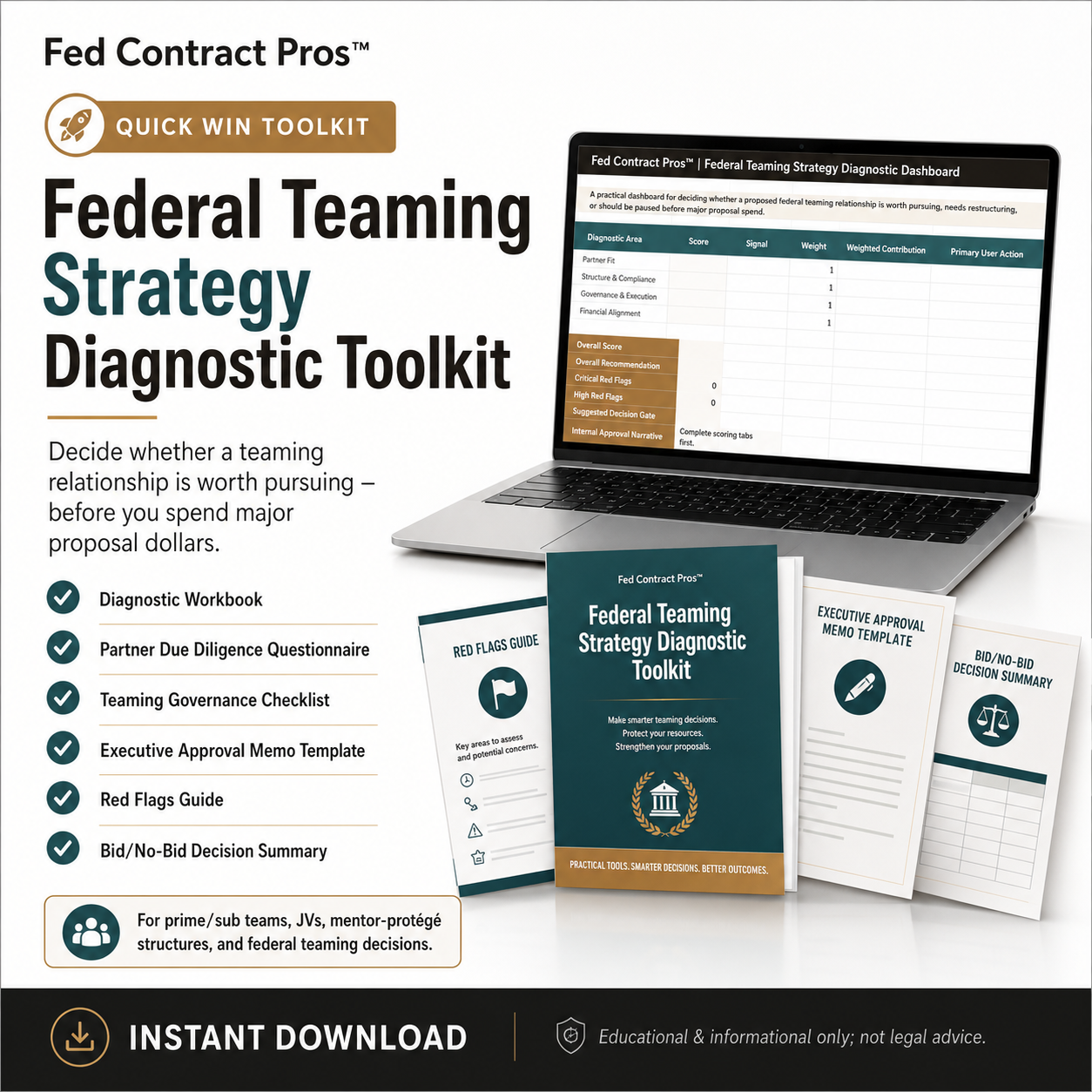
Federal Teaming Strategy Diagnostic Toolkit
Decide whether a federal teaming relationship is worth pursuing — before you spend major proposal dollars.
A teaming agreement is not a teaming strategy.
Federal contractors often enter teaming relationships too late, choose the wrong partner, accept vague workshare assumptions, or rely on a relationship that looks good in a proposal but becomes difficult to execute after award.
The Federal Teaming Strategy Diagnostic Toolkit helps you step back before you commit significant bid resources and ask the right questions:
Is this the right partner?
Is this the right structure?
Is the relationship compliant?
Can the team actually perform?
Are the financial incentives aligned?
Can leadership approve the added complexity and bid cost?
This toolkit gives federal contractors a practical, structured way to evaluate prime/sub relationships, joint ventures, mentor-protégé structures, small business teaming strategies, and other federal pursuit partnerships before they become expensive mistakes.
Instant download. Editable Excel, Word, and PDF files.
Educational and informational only; not legal advice.
Users must tailor content to their contracts and requirements.
Not designed for classified or cleared-contract environments.Price: $147
$97 as an introductory launch price
Stop treating teaming as a last-minute proposal attachment.
Many federal contractors treat teaming as something to “paper” after the capture strategy is already set.
That is a mistake.
The wrong teaming relationship can weaken your proposal, create compliance risk, confuse customer messaging, increase bid costs, undermine pricing strategy, and create operational friction after award.
The right teaming strategy can improve win probability, strengthen past performance, support eligibility, reduce competitive disadvantage, clarify execution, and give leadership a better basis to approve the pursuit.
This toolkit helps you evaluate the relationship before the team becomes locked into a strategy that may be hard to unwind.
Built for real federal contracting decisions.
Use this toolkit before you:
Sign a teaming agreement.
Agree to serve as a subcontractor.
Invite another company onto your team.
Form or evaluate a joint venture.
Consider a mentor-protégé JV.
Rely on a small business, 8(a), HUBZone, SDVOSB/VOSB, WOSB/EDWOSB, or other teaming pathway.
Ask leadership to approve a pursuit with added bid cost or operational complexity.
Spend serious proposal dollars.
This is not a generic teaming agreement template. It is a strategy and readiness diagnostic designed to help you decide whether the teaming relationship is worth pursuing, needs restructuring, or should be paused before proposal spend escalates.
What you get
1. Federal Teaming Strategy Diagnostic Workbook
An editable Excel workbook that helps you evaluate the teaming relationship across the major decision areas that matter in federal pursuits.
The workbook includes structured scoring for:
Partner fit
Structure and compliance
Governance and execution
Financial alignment
Red flags
Bid/no-bid implications
Internal approval narrative
The dashboard produces a practical decision signal so you can determine whether to proceed, proceed with conditions, restructure, replace the partner, or pause the pursuit.
2. Partner Due Diligence Questionnaire
A practical questionnaire for assessing whether a proposed teammate can actually support the pursuit and performance strategy.
Use it to evaluate:
Relevant past performance
Customer and agency experience
Technical and operational capability
Proposal responsiveness
Compliance posture
Key personnel
Financial and insurance considerations
Conflicts and integrity concerns
Information-sharing expectations
Performance risk
This helps you avoid relying on a partner simply because they look good on paper.
3. Teaming Governance Checklist
A practical governance tool for defining how the parties will work together before and after proposal submission.
Use it to clarify:
Capture leadership
Proposal responsibilities
Pricing coordination
Customer communication rules
Information exchange protocols
Decision rights
Escalation paths
Workshare assumptions
Subcontract negotiation timing
Post-award transition planning
Performance management
Dispute escalation
This is where many teaming relationships fail. The checklist helps force the right conversations before the proposal is submitted.
4. Executive Approval Memo Template
A Word template designed to help explain the teaming strategy to leadership, finance, legal, contracts, capture, and operations.
The template helps organize:
Why teaming is required or advantageous
Recommended teaming structure
Strategic rationale
Compliance considerations
Operational execution model
Financial alignment
Bid cost justification
Key risks and mitigations
Decision requested
A strong teaming strategy often fails internally because the business case is not explained clearly. This template gives you a better starting point.
5. Federal Teaming Red Flags Guide
A practical guide to warning signs that a teaming relationship may need to be paused, restructured, or abandoned.
The guide helps identify concerns such as:
Wrong partner selection
Late-stage teaming decisions
Weak governance
Unclear workshare
Misaligned financial expectations
Insufficient operational planning
Poor communication practices
Overreliance on legal paperwork
Unclear proposal and performance roles
Use this guide before the relationship becomes difficult or expensive to unwind.
6. Bid/No-Bid Decision Summary Template
A concise decision document for summarizing whether the teaming relationship supports the pursuit strategy.
Use it to document:
Recommended decision
Key advantages
Key risks
Conditions to proceed
Required mitigations
Internal approval rationale
Next steps
This gives the team a cleaner way to move from discussion to decision.
7. Sample Completed Diagnostic
A sample diagnostic showing how the toolkit can be used to evaluate a federal teaming opportunity.
This helps users understand how to apply the tool without starting from a blank page.
8. Quick-Start Guide
A plain-English guide that explains how to use the toolkit in a single working session.
The goal is simple: help you make a smarter teaming decision before proposal costs, partner expectations, and internal commitments become harder to reverse.
Best suited for
This toolkit is designed for:
Federal contractors evaluating a prime/sub teaming relationship.
Small businesses being approached by larger primes.
Prime contractors looking for the right teammate.
Companies considering a joint venture.
Companies evaluating mentor-protégé JV structures.
Contractors pursuing set-aside or small-business-related teaming strategies.
Capture teams preparing for a major federal pursuit.
Executives who need a clearer business case before approving bid spend.
Legal, contracts, business development, and operations teams that need a shared framework for teaming decisions.
Why this matters
A weak teaming relationship can cost far more than the price of a toolkit.
Federal proposals often require significant time, internal labor, consultant support, pricing work, technical writing, and executive attention. A flawed teaming strategy can waste those resources before the proposal is even submitted.
The cost of getting teaming wrong can include:
Wasted bid spend
Lost proposal credibility
Confused customer messaging
Compliance concerns
Weak past performance strategy
Poor workshare assumptions
Pricing misalignment
Operational friction after award
Subcontract negotiation disputes
Damaged partner relationships
The right diagnostic process does not guarantee a win. But it can help you avoid preventable mistakes and make better pursuit decisions.
The Fed Contract Pros™ approach
Fed Contract Pros™ tools are built for practical use by federal contractors.
This toolkit aligns with the G.R.I.D.S. framework by helping contractors Initiate Relationships more strategically and Draft Winning Proposals with a stronger teaming foundation.
The focus is not theory. The focus is decision support.
Use the toolkit to evaluate the partner, pressure-test the structure, identify red flags, build the internal approval story, and decide whether the pursuit should move forward.
What this toolkit is not
This toolkit is not a substitute for legal advice.
It is not a teaming agreement template.
It does not guarantee compliance, eligibility, award, or successful contract performance.
It does not replace review by qualified legal counsel, SBA counsel, procurement counsel, or other advisors where specific legal, regulatory, or contractual issues are involved.
It is an educational and informational tool designed to help federal contractors organize their thinking, identify key issues, and make more disciplined teaming decisions.
Included files
Federal Teaming Strategy Diagnostic Workbook — Excel
Quick-Start Guide — Word and PDF
Federal Teaming Red Flags Guide — Word and PDF
Executive Approval Memo Template — Word and PDF
Partner Due Diligence Questionnaire — Word and PDF
Teaming Governance Checklist — Word and PDF
Bid/No-Bid Decision Summary Template — Word and PDF
Sample Completed Diagnostic — Word and PDF
Today: $97 (instant download)
This product is an educational and drafting tool. It is not legal advice and does not create an attorney-client relationship. Users must tailor the content to their contracts, systems, workforce, and legal requirements.